Why This Step Matters
The Step That Changes Everything.
Step 01 gave you the vocabulary. Step 02 is where you act on it. Most patients don't realize they have to ask for genomic sequencing — many oncologists won't volunteer it, especially in community settings outside major academic centers. The good news: insurance coverage has expanded significantly, and once you ask, the process moves forward. The hard part is the asking.

Ask. Then Demand.
Bryce's whole movement started with three words: "Sequence Me Now." Say them. Mean them. Walk in prepared.
Bring This Into The Room
The Battle Plan.
Bryce built this. It's the printable doctor-conversation guide he wished he'd had at his own diagnosis. Updated annually by the Motley Crew. Free. Print it before your appointment, fold it in your pocket, and use it as your checklist.
Free · Printable · Yours
The Battle Plan.
A one-page doctor-conversation guide. Every question you need to ask, every term you need to know, every box you need them to check. The single highest-engagement artifact on the entire Sequence Me Now site — because it works.
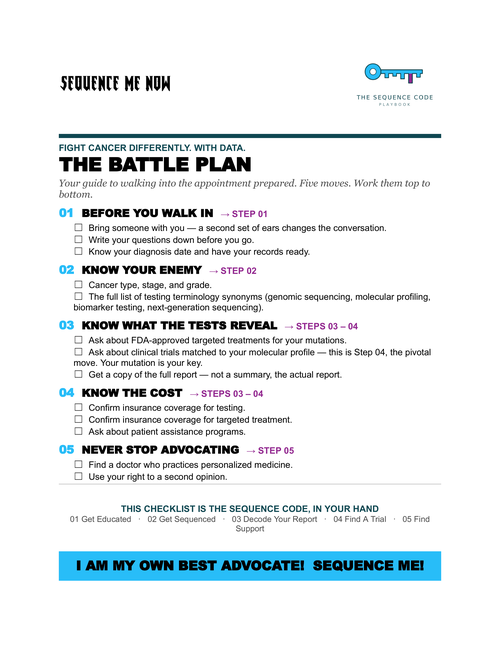 Click to view full size
Free, printable, updated annually. Print before your appointment, fold in your pocket, walk in armed.
When You Ask
Get Specific.
Standard gene panels miss things that whole genome, whole exome, or RNA sequencing can catch. Ask whether tissue, blood, or both makes sense — tissue gives a richer picture, liquid biopsy captures what’s circulating now. And know that your tissue samples are finite and yours to manage: find out where they’re stored and what it takes to send them elsewhere. You may need them later.
Before You Walk In
Check Your Coverage.
Most major insurance plans, including Medicare and Medicaid, cover genomic sequencing when it's medically necessary. Coverage varies by your specific plan, the type of cancer you have, which genes are being tested, whether the test is FDA-approved, and your doctor's clinical justification. Verify before the appointment so the conversation can focus on what's possible, not what it costs.
⚠ Three Questions To Ask Your Insurance
1. "Does my plan cover tumor genomic sequencing for [my cancer type]?"
2. "Will I need prior authorization?"
3. "What's my out-of-pocket cost?"
Have your policy number ready when you call. Get the answers in writing if possible.
What's Usually Covered
- Targeted gene panels (specific genes relevant to your cancer)
- Comprehensive genomic profiling (broader testing) when clinically indicated
- FDA-approved tests
- Tests ordered by your oncologist with clinical documentation
Per NCCN guidelines, genomic testing is now recommended for many cancer types to guide treatment decisions.
If Coverage Is Denied
- Your doctor can appeal with clinical justification
- Many testing labs have patient assistance programs that reduce or eliminate costs
- Some academic medical centers offer testing at reduced rates
- Manufacturers (Foundation Medicine, Tempus, Caris, Natera) often have financial aid
Denial isn't the end. It's the start of the appeal.
In The Room
Five Things To Walk Out With.
When you sit down with your oncologist, these five things turn the conversation into action. Don't leave the appointment without them.
An order for comprehensive genomic profiling — broad panel, not narrow.Comprehensive testing finds drivers narrow panels miss. Ask specifically for "comprehensive" or "broad-panel" genomic profiling.
Confirmation of which testing lab will be used (Foundation Medicine, Tempus, Caris, Natera, etc.)Different labs run different panels. Knowing which lab matters for trial-matching later in Step 04.
An estimated turnaround time for results.Usually 10–21 days. If your oncologist says longer, ask why.
Clarity on how you'll receive the report — patient portal, email, or in-person review.Reports often arrive in your patient portal before your doctor reviews them. Knowing the channel matters.
A scheduled follow-up appointment to review the results.Don't leave the report-reading to a phone call. Schedule a real conversation. This is Step 03.
If You Hit Resistance
When Your Oncologist Says No.
It happens. Some oncologists, especially in community hospitals, don't routinely order genomic sequencing. That doesn't mean the answer is no — it means you escalate.
Three Escalation Paths
1. Ask why. Sometimes the answer is "not standard for your stage" — which may not match current NCCN guidelines. Bring the guidelines (your oncology team can provide them) and revisit.
2. Get a second opinion. Major academic cancer centers (OHSU, UCSD Moores, MD Anderson, Memorial Sloan Kettering, Dana-Farber) order sequencing routinely. A consultation may be worth the travel.
3. Use a direct-to-patient testing service. Some labs (e.g., Tempus xT for patients, Foundation Medicine FoundationOne) have programs that work with your existing oncology team or order directly.